A practical guide for activewear brands choosing the right thermal management technology
If you’re sourcing activewear, you’ve seen the claims:
“Cooling fabric.” “Instant chill.” “Ice-touch feel.”
They’re everywhere. But here’s the uncomfortable truth—most cooling fabrics on the market today are passive solutions. They only work when you’re already sweating.
And in a market where “cooling” is printed on every other hangtag, it’s no longer a differentiator. It’s table stakes.
The brands winning right now—Nike with its ACG Radical AirFlow, Lululemon with SenseKnit, and a wave of technical outdoor labels—are asking a different question:
What if your garment could actively respond to body temperature changes?
This article breaks down where cooling fabric technology stands today, what “active temperature regulation” really means, and how to choose the right approach for your product line.
1. The Cooling Technology Stack: Three Generations
Generation 1 — Passive Cooling (Moisture Management)
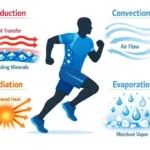
How it works: Wicking fabrics pull sweat from the skin to the fabric surface, where it evaporates. Evaporation = cooling.
Common materials: Polyester microfiber, nylon wicking knits, hydrophobic/hydrophilic gradient structures.
Limitations:
- Only works when you’re already hot enough to sweat
- Performance drops in high humidity
- No active cooling—just faster drying
- Widely available, no competitive edge
Best for: Base layers, gym wear, low-intensity activity
Generation 2 — Instant-Cool (Contact Cooling)
How it works: Fabrics infused with minerals (jade, tourmaline) or coated with cooling agents that create a “cold touch” sensation when the fabric contacts skin.
Common materials: Coolmax® AIR, Nilit Breeze, mineral-infused nylon, xylitol-coated fabrics.
Limitations:
- The cool-touch effect fades after a few minutes of wear
- Durability depends on wash cycles (coatings wash off)
- Still passive—doesn’t adapt to changing body temperature
- The market is saturated—every supplier offers “ice-touch” fabric
Best for: Yoga wear, casual activewear, short-duration activities
Generation 3 — Active Temperature Regulation (The Frontier)
How it works: Materials that actively absorb, store, or release heat in response to body temperature changes. The fabric “breathes” with you.
Technologies driving this:
| Technology | How It Works | Key Players/Examples | Price Premium |
|---|---|---|---|
| Phase Change Materials (PCM) | Microcapsules embedded in fibers absorb excess heat (melting at ~28-32°C) and release it when body cools | Outlast®, Comfortemp®, Thermocules | +15-30% |
| Airflow Engineering | Funnel-shaped knit structures accelerate air movement across skin as the body moves | Nike ACG Radical AirFlow, Under Armour Iso-Chill | +10-25% |
| Bimetallic / Adaptive Textiles | Fabric structure changes porosity in response to temperature (opens when hot, closes when cold) | MIT adaptive fabrics, Nusori | Early stage |
| Knit Ventilation Mapping | Body-mapped zones with different knit densities/structures for targeted heat release | Lululemon SenseKnit, Nike Aerogami | +5-15% |
What makes Gen 3 different:
- It’s adaptive, not static
- Works before you overheat (proactive)
- Retains performance across multiple washes
- Actually measurable—UPF 50+, air permeability, thermal resistance (clo value)
2. What You Need to Know Before Sourcing Cooling Fabrics
Don’t fall for the “ice-touch” marketing trap
“Instant cooling” feels great in a showroom. But put that fabric on a customer running 10K in 32°C Shanghai summer—the sensation fades in 3-5 minutes. What remains is just a polyester or nylon fabric with no active cooling properties.
Ask your supplier these questions:
- Is the cooling effect wash-durable? If it’s a coating, it’s not. Ask for test data after 20/50 washes.
- What’s the Qmax value? Qmax measures cool-touch contact. ≥0.15 W/cm² is entry-level instant cool. ≥0.25 W/cm² is premium.
- Does the fabric have active PCM or is it wicking only? If they can’t explain the difference, they’re selling Gen 1.
- What’s the BREATHABILITY (air permeability)? A “cooling” fabric that doesn’t breathe is worthless. Minimum 150 mm/s for activewear.
- Can you certify the technology origin? PCM microcapsules should be traceable to suppliers like Outlast, BASF, or Devan.
Real cost comparison (per yard estimates)
| Technology | Fabric Cost | MOQ | Wash Durability | Complexity |
|---|---|---|---|---|
| Standard wicking polyester | $3-5 | Low | ✅ 50+ washes | Low |
| Coolmax AIR / Nilit Breeze | $6-9 | Medium | ✅ 30+ washes | Low |
| Mineral-infused instant cool | $5-8 | Low | ⚠️ 15-25 washes | Low |
| PCM-infused (Outlast®) | $8-14 | Medium-High | ✅ 50+ washes | Medium |
| Airflow engineering knits | $7-12 | High | ✅ 50+ washes | Medium-High |
| Body-mapped ventilation | $10-18 | High | ✅ 50+ washes | High |
3. Which Technology Fits Your Product Line?
Scenario A: Yoga & Low-Intensity Studio Wear
Recommendation: Gen 2 instant-cool + moisture wicking
Why: Low heat output during practice. Contact cooling is sufficient. Cost-sensitive segment.
Example fabrics: Mineral-infused nylon/spandex, Qmax >0.20 W/cm²
Scenario B: Running, HIIT & High-Intensity Training
Recommendation: Gen 3 PCM or airflow engineering
Why: High sweat rate. Need sustained cooling that doesn’t fade. Body-mapped ventilation zones add real performance value.
Example fabrics: Outlast PCM blends, ventilated mesh-back panels
Scenario C: Outdoor Hiking & Commuter
Recommendation: Gen 3 airflow engineering + climate-adaptive
Why: Temperature fluctuates during the day (morning cool → midday sun → evening breeze). Adaptive response is the key advantage.
Example fabrics: Wind-resistant front panels + PCM back panels, strategic venting
Scenario D: Budget-Conscious Basics
Recommendation: Gen 1 high-quality wicking
Why: Not every product needs Gen 3. A well-engineered wicking fabric (e.g., 100% recycled polyester with channeled fibers) still outperforms cheap “ice-touch” alternatives.
Example fabrics: Recycled polyester wicking, Coolmax®
4. The Business Case: Why Invest in Advanced Cooling?
From a brand perspective
| Metric | Gen 1 Wicking | Gen 3 PCM / Airflow |
|---|---|---|
| Retail price potential | $25-45 | $60-120 |
| Consumer perceived value | Low (expected) | High (premium tech story) |
| Differentiation | Commodity | Defensible |
| Repeat purchase driver | Low | High (real performance difference) |
| Returns due to “too hot” | Moderate | Low |
The Community Factor
In a recent LinkedIn discussion that attracted over 220 engagements, performance material experts agreed: cooling fabrics are no longer enough as a standalone feature. The market has moved past “basic cooling” into active thermal regulation.
Brands that can tell a credible Gen 3 technology story—traceable PCM, engineered airflow, wash-durable performance—will capture the premium segment in 2026-2027.
5. How GoSportLand Can Help
As a manufacturer specializing in activewear and outdoor performance gear, GoSportLand works with multiple cooling technology suppliers:
- ✅ Outlast® PCM certified fabrics — for active temperature regulation
- ✅ Coolmax® AIR & Nilit Breeze — for high-performance wicking
- ✅ Custom mineral-infused instant cool knits — for yoga & studio lines
- ✅ Body-mapped ventilation knitting — for high-intensity and outdoor gear
- ✅ Low MOQ available — start with 50-100 pcs per color
We’re not just a fabric supplier—we engineer garments from fiber to finish. Our R&D team can help you select the right cooling technology for your price point, activity type, and target market.
Contact us → to discuss your next collection.
This article was developed with insights from industry R&D professionals, textile testing standards (AATCC, ASTM, JIS), and publicly available technology specifications. The analysis reflects GoSportLand’s 20+ years of experience in activewear manufacturing and material innovation.